
Estimated Reading Time: 5 minutes
Walk into a modern flight school today and you may find students learning to fly long before the engine starts.
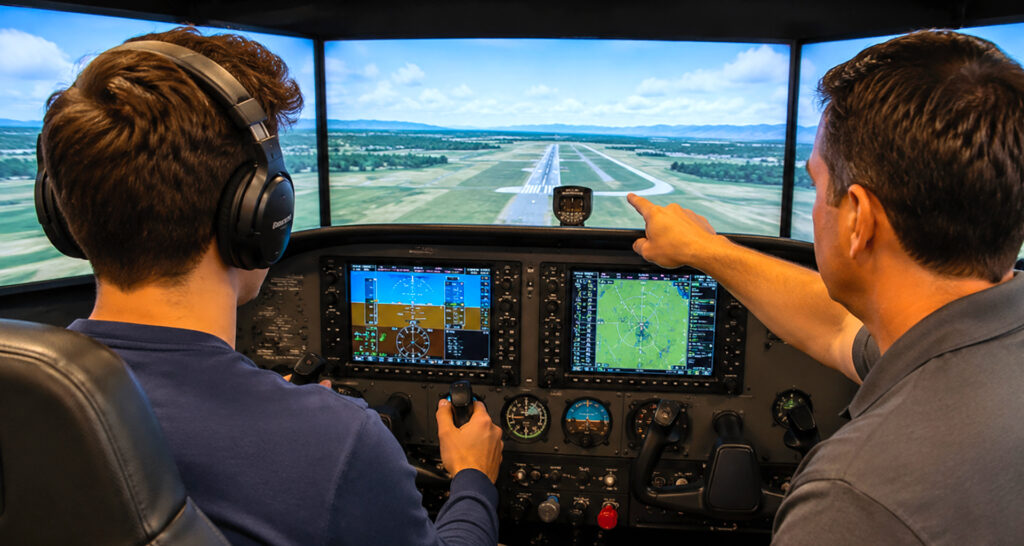
Advanced aviation simulators and Flight Training Devices have become valuable tools for helping students practice procedures, develop cockpit familiarity, prepare for instrument flying, and work through situations that would be difficult—or sometimes unsafe—to recreate in an actual aircraft.
And now, as artificial intelligence becomes more sophisticated, the possibilities for simulator-based training are becoming even more interesting.
But does that mean simulators are replacing airplanes? Not even close.
Instead, the future of flight training may be about using simulators and real aircraft together more effectively.
Why Simulators Have Become Such a Valuable Training Tool
Every hour in an aircraft costs money.
There’s fuel, maintenance, engine time, instructor time and the overall operating cost of keeping that airplane in the air.
A simulator gives students another environment where they can practice certain skills without putting hours on an actual aircraft.
Depending on the device and training objective, students can work on instrument procedures, navigation, checklist discipline, radio and cockpit procedures, emergency scenarios, systems knowledge, and cross-country planning.
And one of the biggest advantages is simple: you can stop, reset and try again.
That’s something you can’t always do at 3,500 feet.
Practice the Situations You Don’t Want to Experience for the First Time in an Airplane
One of the most valuable parts of simulator training is scenario-based learning.
An instructor can introduce a problem and allow the student to work through it in a controlled environment.
What happens when the weather suddenly deteriorates? What if an instrument fails? How should the pilot react to an abnormal indication? What happens when the workload starts piling up?
Students can experience challenging scenarios, make decisions, discuss what happened with their instructor and then repeat the exercise.
That repetition can help reinforce procedures before a student encounters a demanding situation in the real world.
Where AI Could Take Flight Training Next
This is where things get particularly interesting.
As AI capabilities are incorporated into aviation training technology, future systems may become increasingly capable of adapting scenarios to individual students, evaluating performance patterns and creating more dynamic training environments.
Imagine a simulator recognizing that a student consistently struggles with a particular procedure and providing additional scenarios that focus on that weakness.
Or training software creating changing weather, traffic and operational situations that force the student to continually evaluate what’s happening rather than simply memorizing a sequence of actions.
Technology can make training more sophisticated. But it doesn’t eliminate the need for a qualified flight instructor.
The instructor still teaches judgment. And in aviation, judgment matters just as much as knowing which button to push.
Simulator Time Can Make Aircraft Time More Productive
This may be the biggest benefit for flight schools. Aircraft time is valuable.
If a student can learn and rehearse an appropriate procedure on the ground, the lesson in the aircraft can focus more heavily on applying those skills in the real flying environment.
That can make training sessions more purposeful.
Instead of spending expensive aircraft time becoming familiar with every step of a procedure for the first time, students may arrive at the airplane already understanding what they’re expected to do.
For students preparing for a checkride, that extra repetition can also help build confidence and procedural consistency.
The amount of simulator time that can officially count toward a certificate or rating depends on the device, training program and applicable FAA requirements. But even when a simulator session isn’t a substitute for required aircraft experience, it can still be an extremely useful preparation tool.
But There’s One Thing a Simulator Can’t Replace
Eventually, you have to fly the airplane.
A simulator can’t completely recreate the feeling of a crosswind pushing the airplane during a landing.
It can’t perfectly reproduce turbulence on a summer afternoon.
It can’t fully replicate the sight picture, control pressures, sounds, distractions and decision-making that happen in an actual aircraft.
And it certainly can’t replace the confidence that comes from learning to safely operate a real airplane.
That’s why the best training strategy isn’t necessarily simulator versus aircraft. It’s simulator plus aircraft.
Use technology to prepare. Use the airplane to turn that preparation into real-world flying experience.
The Modern Flight School Needs Both
As flight training continues to evolve, students will increasingly expect access to modern technology.
Flight schools may invest in advanced simulators, updated avionics, digital training tools and new instructional methods.
But all of that technology ultimately leads back to one fundamental requirement: you still need an aircraft available when it’s time to fly.
A student can spend hours preparing in a Cessna 172 simulator, but when it’s time to take that training into the sky, the school needs a real training aircraft sitting on the ramp.
And if every airplane is booked—or one is down for maintenance—the benefits of efficient simulator preparation can quickly run into an aircraft-availability problem.
Where Eye Candy Aviation Fits In
At Eye Candy Aviation, we believe flight schools should be able to invest in the future of training without putting all of their available capital into purchasing aircraft.
Leasing can provide another way to expand fleet capacity while preserving funds that can be used elsewhere in the business—including instructors, facilities, simulators and other training technology.
Our Cessna 172 aircraft are designed to support the high-utilization environment of flight training, and available aircraft may include modern avionics configurations such as Garmin equipment.
Schools operate and care for the aircraft day to day while Eye Candy Aviation helps take on major lifecycle responsibilities, including covered engine and propeller overhaul events under the terms of the lease, provided the aircraft has been properly operated and maintained.
The result is a simple combination: better tools on the ground, reliable aircraft in the air
Technology Is Changing. The Mission Isn’t.
From basic training devices to today’s increasingly sophisticated simulators, aviation training technology has come a long way.
And AI may take it even further.
But the ultimate goal hasn’t changed.
Train knowledgeable pilots. Build good judgment. Develop confidence. And give students the real- world experience they need to become safe aviators.
For flight schools, that means combining the best training technology available with something that will always remain essential: a reliable airplane ready to fly.
When your simulator is helping students become more prepared but your fleet needs additional capacity to get them into the sky, Eye Candy Aviation is ready to help.
Aviation Trivia
Did you know? One of aviation’s most famous early flight-training devices was the Link Trainer, developed by Edwin Link around the turn of the 1930s.
Its enclosed cockpit and motion system helped pilots practice instrument flying without ever leaving the ground—a concept that helped pave the way for the sophisticated flight simulators used today.